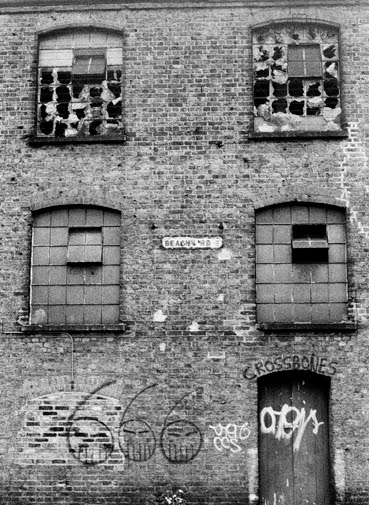
The Hardy Tree Gallery, a tiny, boundary pushing arts space on Pancras Road is currently showing a wonderful exhibition of black and white photos by local artist Hisano Luttman. Born in Japan, Luttman moved to Kings Cross over twenty years ago. She has lived there ever since, a resident of what is sometimes referred to as Somers Town. Between 1988-1990 she documented the area in a personalised photographic portrait of the streets and architecture. Today, in 2012 the pictures appear to come from a completely different world. A bygone era of London rapidly disappearing underneath ceaseless modernisation. The gallery, itself situated in the heart of St Pancras is overlooked by the shiny new behemoth of the Eurostar terminal. The beautiful gasometers in Luttman's pictures have all been ripped out and the skies are instead littered with the sight of cranes lifting and moving building materials. New buildings have emerged, creeping skywards. New, expensive looking roads have replaced the dark, dingy streets once stalked by prostitutes and drug dealers. The British Library and The Guardian are neighbours in the area. The UK Centre for Medical Research is currently building its new £500 million home on a vacant plot, from where the future of cancer treatments will be mapped out. The beautiful St Pancras Renaissance Hotel has reopened after lying dormant for decades. The area has seen significant change since Luttman's photos were taken. In an interview with London Loves she told me what the pictures and this area of London mean to her.
London Loves: What does the Kings Cross, St Pancras and
Somers Town area mean to you personally?
Hisano Luttman: This is the place I’ve lived since 1988, sure I have lived somewhere before, but this is the place I call home. As I learnt about the place, the history, I found an attachment, also I became close friends of an old lady (by using the local launderette where she was the service wash girl), a sweet lady, she was in her 80s, born and lived all of her life here, she introduced me to her friends, they became my friends. To them, I was never Hisano, I was Tina, it felt strange, but also natural. I met her family, and she met mine. This was where the sense of belonging really came from. I remember she told me about the Chalton Street of her youth, a busy marketplace 7 days a week, this pokey little street sandwiched between Euston and St Pancras. Sainsbury’s, all this street, both sides was stalls, a Jewish furniture shop, a silk stocking place… that’s how the area came alive to me.
Hisano Luttman: This is the place I’ve lived since 1988, sure I have lived somewhere before, but this is the place I call home. As I learnt about the place, the history, I found an attachment, also I became close friends of an old lady (by using the local launderette where she was the service wash girl), a sweet lady, she was in her 80s, born and lived all of her life here, she introduced me to her friends, they became my friends. To them, I was never Hisano, I was Tina, it felt strange, but also natural. I met her family, and she met mine. This was where the sense of belonging really came from. I remember she told me about the Chalton Street of her youth, a busy marketplace 7 days a week, this pokey little street sandwiched between Euston and St Pancras. Sainsbury’s, all this street, both sides was stalls, a Jewish furniture shop, a silk stocking place… that’s how the area came alive to me.

© Hisano Luttman
London Loves: What's the biggest change you've seen or felt in the 20+ years
you've lived in the area?
Hisano Luttman: The people. When I arrived there some of the older people felt
to me like the characters of those old films, the Ealing or the Gainsboroughs,
remainders of another age. Those people had an inherent sense of Britishness. I
knew the people who had lived all their lives in this area, who had spent their
lives for example working in the local industries, on the railways, they were a
part of the local fabric. But now they’ve gone. Those that remain, they may be
the same people – people who’ve spent their lives around here, but their
experience are different, they weren’t shaped in the same way.
London Loves: Talk us through your favourite photo from the exhibition and what
you like about it/what it says about the area...
Hisano Luttman: The shot of the kings cross parcel yard (main pic), it contains everything
I loved about the area; the brickwork, the cobbles, the gasometers, the railway
lodging house…. People have said to me it looks Victorian, but I did nothing,
just snapped it, that was how it was and that was how I caught it.
London Loves: Are you positive about the future for Kings Cross?
Hisano Luttman: I am not sure … the change was needed, it had to happen, but
what I see now is a community sidelined, nothing really for the locals. It’s
like, to the east of the Pancras Road, everything is new and
modern, you cross over into Brill place and you’re in Somers Town, nothing has
changed. All this wealth and yet for the people who have lived here all their
lives, the old people, the day centre – the lunch club, shut down last year,
not because there are no old people, but because of cuts to services. So where,
I ask, are the benefits to the community from all this money?

London Loves: You must have seen a lot happen in these streets or from your balcony... tell us the good and bad things you've seen in the area.
Hisano Luttman: Somers Town is actually a warm place, a small place. And once you are inside it, the community itself is quite close. We look after each other and know each other. It doesn’t mean you nod an hello to everybody, it’s more that even if you don’t know the gang of kids hanging out on the corner, once they’ve seen you a few times, they know you are local, so they’ll leave you alone. It’s an inclusive community.
On the downside, when they cleaned up the worst parts of the Cross (Argyle Square), they didn’t solve the problem of the hardcore drug addicts and prostitution, they just displaced them. We caught the fall out and for a few months, it was not a nice place to be. Of course we have our own problems, every place does, but we saw them triple or quadruple overnight. We got over the worst – largely thanks to a dedicated ward councillor continually pestering the Council and Police, but again they – the addicts and prostitutes were just moved on, it just make’s me wonder where they went.
London Loves: Does anywhere in London feel even remotely like Japan?
Hisano Luttman: Department stores – English departments stores before were really old fashioned. You had departments (fashion, haberdashery, kitchen appliances etc), but now the department stores like Selfridges, the layout is like Japanese stores, so you’ll walk form a section selling one brand, into another selling a rival brand, into another, all within a single department … that’s very Japanese. But the service, no, English assistants don’t have it. Also in the sense of the shopper – especially young people, before they would look for individuality, visit markets, look for the little shop that was special, but now it all seems to be Brand driven and that to me is a very Japanese thing. And it’s inherently sad that I think you’ve lost that, because with it you lose the individuality, the flair…. It’s a funny thing, because back in the 80’s that’s something we Japanese studied of the English – that individuality, the music, the fashion, it was so London driven … and yet now its almost - in a way - the opposite.
London Loves: There are so many people in London from every part of the world, I always wonder do they feel at home here. Do you?
Hisano Luttman: I can only speak for myself, and as someone who came here – not born here. If someone asks me where is my home, Nagoya or London, I would always say Nagoya, because I always feel – even after all of this time and all of my positive experiences – I still feel like I am a bit of an ‘alien’. But, whenever I go back to Japan, then I miss London, I want to come back, because when I am there I feel in some unexplainable way estranged from Japanese society – not like I don’t fit or have my place, but like I have seen or lived too much to feel totally comfortable with it – questioning my actions and responses so to speak.
London Loves: What other photographic projects, particularly in London, would you like to do.
Hisano Luttman: As you know, the photos in this exhibition were all taken between 1988 and 1990, around this time I took lots of photos they were never expressly intended for exhibition, they were just me capturing images through my lens. I want to revisit the images I took then, and maybe also revisit some of the places and compare the changes.
St Pancras - A Photographic Diary 1988-1990 is on at the Hardy Tree Gallery, 119 Pancras Road, NW1 1UN until the 2nd September